
Glory Be to Jesus Christ!
🌞
Since in the work published at the link:
https://oleksandr-zhabenko.github.io/en/commentaries/02082025.html
and even earlier in others, published at the links:
https://churchandsociety.org.ua/pdf/projects/zbirnyk.pdf
https://oleksandr-zhabenko.github.io/en/commentaries/17082024.html
https://oleksandr-zhabenko.github.io/en/commentaries/12112025.html
https://oleksandr-zhabenko.github.io/en/commentaries/27112024.html
it is written that the use of prepositions has important significance for the correct understanding of important and topical questions, particularly the question of power, I am writing comments regarding the use of precisely these prepositions. As advice regarding reading what is written — one can read the verse in translation or/and original (whoever has such possibility), and then the corresponding comment regarding prepositions here. Then it is necessary to understand which part of the verse the comment concerns, and also to consider what essential for understanding it affirms — or more rarely — denies. Such thoughtful reading helps to deepen understanding and protects from the mentioned mistakes.
I prepared an improved version of my research, the presentation of which is available at the link:
https://www.facebook.com/Oleksandr.S.Zhabenko/posts/
https://oleksandr-zhabenko.github.io/uk/commentaries/vystup-2025-hypo-genitive-Romans-XIII_1.pdf
The research material is currently being prepared for publication. I hope, God willing, to present fuller results later after the publication comes out.
I will update the list of references regarding prepositions at the links:
https://oleksandr-zhabenko.github.io/en/commentaries/02082025.html
https://oleksandr-zhabenko.github.io/uk/commentaries/Pryjmennyky.html
the latter — once or twice a month (in Ukrainian), to keep the text version current and up to date.
Liturgy:
James IV, 7 — 'ἀφ' ὑμῶν' - 'aph hymon' - from you
. The preposition 'apo' in its form before the following 'hy' indicates here that he will flee completely, entirely.
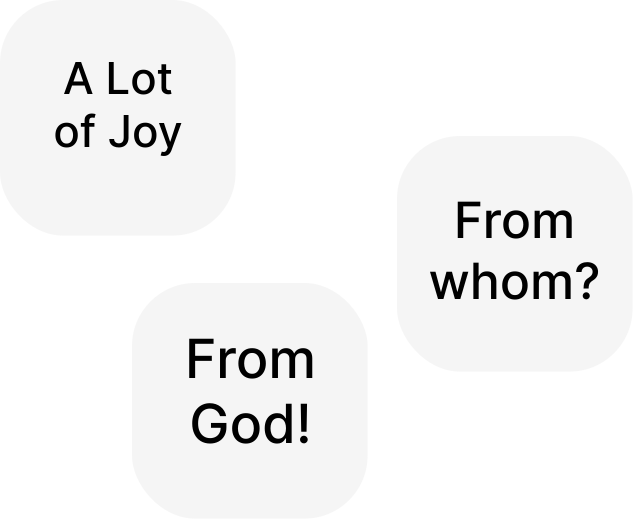
James IV, 9 — 'εἰς πένθος' - 'eis penthos' - into mourning
. 'εἰς κατήφειαν' - 'eis katetheian' - into sorrow; into sadness
. In both cases the preposition 'eis' indicates that into which the laughter and joy are to be transformed. To be transformed
means here a synonym of change of mind
, repentance — through deep awareness and renewal the person is to begin a new life in the Lord. The matter is not in feelings here, but in the new life, renewal. The Apostle does not wish to sadden someone, but wants to turn to the Lord and righteousness.
James IV, 13 — 'εἰς τήνδε τὴν πόλιν' - 'eis tende ten polin' - behold into this city
. Whither.
James IV, 16 — 'ἐν ταῖς ἀλαζονίαις ὑμῶν' - 'en tais alazoniais hymon' - in your arrogances
. The plural indicates that it is spoken about stereotypical incorrect thinking, perception of themselves as directors of events, who know precisely what will be further.
James V, 3 — 'εἰς μαρτύριον ὑμῖν' - 'eis martyrion hymin' - for testimony to you
. The preposition 'eis' indicates here the purpose. 'ἐν ἐσχάταις ἡμέραις' - 'en eskhatais hemerais' - in the last days
. When.
James V, 4 — 'ὁ ἀφυστερημένος ἀφ' ὑμῶν' - 'ho aphysteremenos aph hymon' - those who were kept back from you (that is, those whose payment was delayed by you)
. The preposition 'apo' indicates here that the masters and owners, delaying payment, take away from the workers that which they delay. 'εἰς τὰ ὦτα κυρίου σαβαὼθ' - 'eis ta ota kyriou sabaoth' - into the ears of the Lord Sabaoth (of Hosts)
. That is, have come to the Lord
.
James V, 5 — 'ἐν ἡμέρᾳ σφαγῆς' - 'en hemera sphages' - in the day of slaughter (for food or sacrifice)
. When.
Completion of the ordinary readings on weekdays from the Catholic Epistle of the Apostle James.
The Apostle calls to wisdom and long-suffering.
The Law is appointed to judge sin, and not the person, that is, it provides not only judgement for sinners, but also protection. Therefore the person who considers the Law only as a list of possible violations and punishments
(in the likeness of the Criminal Code) errs. And judging the neighbour, the person easily violates the protective part of the Law by force of his weakness and sinfulness. Hence, judges the Law
.
performer of the Law
— a derivative from the word to create
is used (as to write verses); performer
, therefore, presupposes a creative approach to the Law, not simply mechanical literal performance, but a creative process, as performance of a song, declamation and writing of poetry or music and so forth. To perform the Law (analogously also the Gospel) — means creatively (poetically) to accomplish it in one's own life and the life of others. Does not perform
the Law (Gospel) (does not create the Law (Gospel)) also the person who does not have this co-creation with God. The person who judges neighbours as a judge on the basis of the Law
, does not have full creative co-action with God, Who wishes to save people. And this partiality, according to the beginning of the 2nd chapter of the Epistle, is a violation of everything.
For the reading from the Apostle, see the links:
https://oleksandr-zhabenko.github.io/en/commentaries/26012023.html
For the reading from the Gospel, see the link:
https://oleksandr-zhabenko.github.io/en/commentaries/08012026.html
Of the Venerable Paul of Thebes and John the Hut-Dweller:
For the reading from the Apostle, see the links:
https://oleksandr-zhabenko.github.io/en/commentaries/29122024.html
https://www.facebook.com/Oleksandr.S.Zhabenko/posts/
More about the reading from the Gospel, see the links:
https://oleksandr-zhabenko.github.io/en/commentaries/03072025.html
https://oleksandr-zhabenko.github.io/en/DialogueOnWordsChristFear.html
https://oleksandr-zhabenko.github.io/en/commentaries/08022024.html
https://www.facebook.com/Oleksandr.S.Zhabenko/posts/
https://oleksandr-zhabenko.github.io/en/commentaries/29062023.html
https://oleksandr-zhabenko.github.io/en/commentaries/18072024.html
Glory be to Thee, our God, glory be to Thee!